Показаны сообщения с ярлыком T-38. Показать все сообщения

четверг, 2 апреля 2015 г.

Army Faces Decisions About Airborne Radio

HuntaZeitung. — The US Army is studying two methods to improve communications between its helicopter fleet and soldiers on the ground.
The Small Airborne Networking Radio (SANR) program would instantaneously transmit ground soldier location information to maps in cockpits overhead to minimize fratricide. Soldiers would be able to transmit target coordinates quickly for better air support, whereas today, a pilot will listen to coordinates and write them on a leg pad.
"We've got to get out of that, that's old technology we have now and we have to be smarter," said Maj. Gen. Daniel Hughes, program executive officer for command, control, communications-tactical (PEO C3T). "What we do now has to make sense financially and technically."
The program is expected to draw offerings from more than a half-dozen radio manufacturers, some displayed at the Association of the US Army's convention here this week. Among them, Rockwell Collins showcased its TruNet, and Harris Corp. its Harris Airborne Multi-Channel Radio.
As envisioned, SANR would be a two-channel, software-defined radio that could carry voice and data via Soldier Radio Waveform (SRW), Wideband Networking Waveform (WNW) and the legacy Single Channel Ground and Airborne Radio System (SINCGARS), which transmits voice but not data.
The Army is expected to issue an RFP in 2016 followed by source selection, flight tests and airborne integration and qualification, with a possible award in 2019, according to an industry source. It could take as long as 10 years to field all 7,000 aircraft.
SANR, which is funded in the president's proposed budget, will proceed in 2016. But the service is in the process of deciding on how to move ahead on its requirement for another data link for helicopters, Link 16.
Link 16 is a military tactical data exchange network used by the US and NATO nations. It supports the secure exchange of text messages and imagery, data, and provides two channels of digital voice.
The Army has already fielded an airborne radio that carries Link 16. Through a sole-source procurement in 2013, the Army selected a two-channel radio co-developed by ViaSat and Harris, the small tactical terminal, (STT) for the UH-60 Apache helicopter.
The Army launched a Small Airborne Link 16 Terminal (SALT) program, though an anticipated request for proposals for SALT was put on hold while the Army determines whether it needs SALT in addition to SANR. A decision about how to proceed should be made soon.
"Getting Link 16 into that aircraft is absolutely critical," Hughes said. "Whether we have Link 16 and SRW, the Army is looking at the requirement to make sure we have it right and we have a plan to go forward."
"You have SANR to all the helicopters and SALT to just the Apaches and you have solutions out there to give them the Link 16 capabilities," said Col. James Ross, project manager for tactical radios. "It's a matter of whether we go to the SALT program for that or another means the aviation community will be able to do."
The Army has been developing the SRW over the last few years, but has yet to field it in a wide variety of products or fulfill plans to deploy it across the Army, amid fluctuations in Army networking programs. At the same time, the Army has in recent years demonstrated in its Network Integration Evaluation exercises the use of its Rifleman Radio, which uses SRW, in helicopters.
As the Army proceeds with SANR, the players from the crowded radio market are expected to include BAE, Exelis, General Dynamics, Harris, Northrop Grumman, Rockwell Collins and Thales.
Rockwell Collins launched software-defined ground and airborne radios at the convention under the label TruNet. Rockwell, known for its airborne radio, the ARC-210/Talon, would offer a variant for SANR, company officials said.
Bob Esselborn, the company's account manager for ground tactical radios, said the company's edge is its expertise in porting software-defined radios, like the ARC-210. "Our engineers have been doing this for 10, 15 years and that allows us to be competitive," he said.
Ray Cerrato, Harris' senior manager for business development, showed off its prototype Harris Airborne Multi-Channel Radio at the convention, touting the company's experience with WNW, as the contractor for SRW and as the manufacturer of the Falcon III AN/PRC-152, which supports SINCGARS.
"We're ready to go, we're ready to compete, and Harris is very strong in the waveform arena," Cerrato said.

суббота, 28 марта 2015 г.

Pentagon Finds Air Force Is Spending Billions on Drones It Doesn't Need

Internal watchdog report obtained by Pentagon has questioned the air force’s increased spending on drones, suggesting it is a waste of money


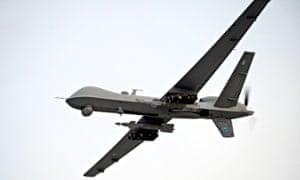
A Reaper drone.
 A Reaper drone. Photograph: SWNS
The Pentagon’s internal watchdog has questioned the air force’s need for 46 armed Reaper drones, and suggested the flying service is wasting $8.8bn on superfluous aircraft.
As purchases of General Atomics’s MQ-9 Reaper ballooned from 60 aircraft in 2007 to the current 401, air force officials did not justify the need for an expanding drone fleet, the Pentagon said.
During that time, costs for purchasing one of the signature counter-terrorism weapons of Barack Obama’s presidency increased by 934%, from $1.1bn to more than $11.4bn, according to a declassified September report by the Pentagon inspector general. Purchasing costs are a fraction of what the drones cost to operate and maintain over their time in service: in 2012, the Pentagon estimated the total costs for them at $76.8bn.
The Guardian obtained a copy of the inspector general’s report under the Freedom of Information Act.
Responding to heavy demand for additional aerial intelligence from troops deployed in Afghanistan, Iraq and elsewhere, the former defense secretary Leon Panetta in 2011 ordered the air force to buy sufficient drones to perform 65 combat air patrols, missions that require up to four aircraft to observe a target for nearly 24 hours.
But the air force’s air combat command “did not conduct and maintain consistent, complete and verifiable analyses for determining the necessary MQ-9 procurement quantity”, the inspector general found. Combing through insufficient or incorrect air force analyses, Pentagon investigators found that the officials “could not provide the underlying support for aircraft quantity determinations” and sidestepped a bureaucratic process for determining needed capabilities.
Military officers, however, have complained that expanding missions have overtaxed the drone fleet. In November, anonymous officials told the Daily Beast a drone shortage for surveillance and attack missions against the Islamic State (Isis) contributed to an intelligence shortfall against a premier US battlefield target.
Pentagon inspectors found that the air force’s inability to justify its continuing Reaper purchases risks wasting $2.5bn for 13 mission-ready drones; $2.1bn for 11 training drones; $958m for five test drones; $766m for four air national guard drones; and $1.7bn for nine attrition-reserve drones.
The per-cost waste of the questionable drone purchases works out to roughly $192m for each of the 46 Reapers the inspector general was unable to justify buying.
The air combat command’s director of plans said the Pentagon study significantly overstated the potential waste costs, pegging it at $593.4m for 46 Reapers instead of nearly $9bn, and underestimated the stress on the air force to provide sufficient drones for commanders.
“We are concerned that your report does not highlight these dynamic characteristics of an MQ-9 program that evolved during a period of significant conflict to meet warfighter needs at OSD [Office of the Secretary of Defense] direction,” Major General Scott J Zobrist wrote to the inspector general in August.
The inspector general replied that it included operational and support costs in its estimate, commensurate with air force acquisition data for the Reaper, to account for the discrepancy.
While not conceding that the air force does not need the 46 Reapers, Zobrist directed his staff to incorporate the inspector general’s criticisms “in our ongoing MQ-9 cost and capability ISR [intelligence, surveillance and reconnaissance] gap study”, due in March 2015. That study addresses the inspector general’s chief recommendation for the Reaper purchases.
After the inspector general released an unclassified synopsis of the report in September, the air force claimed the watchdog relied on outdated, year-old information.
“The air force is only buying 346 aircraft, 55 fewer than the 401 figure contained in the report and we’ve only received about half that number. The projected total Reaper fleet of 346 is far less the service had originally estimated prior to sequestration,” a three-star air force general told the aviation website FlightGlobal.
A different senior air force official, Major General John Winters, agreed with the inspector general that the Air Force Requirements Oversight Office “should validate necessary MQ-9 quantities and costs in an updated requirements document”

воскресенье, 22 марта 2015 г.

Will the T-X save Boeing jobs?

In April 2008, a T-38 trainer took off from Columbus Air Force Base in Mississippi. Within seconds, it rolled onto its back and crashed, killing the instructor and student.
A metal lever had broken on an aileron, a wing control surface, causing the plane to flip.
The T-38 was a very old plane then, and it’s older now. Northrop Grumman built the first in 1959 and ended production in 1972. But it’s still one of the main means of training military pilots.
Now, the Air Force would like to replace these flying antiques, rather than launch another round of structural fixes designed to prevent accidents.
That desire just might possibly hold promise for jobs at Boeing in St. Louis.
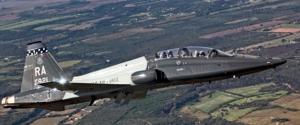
OVER LACKLAND AIR FORCE BASE, Texas -- A T-38 Talon participates in the 2004 Lackland Airfest. (U.S. Air Force photo by Master Sgt. Lance Cheung)
Boeing is teaming with Saab, the Swedish maker of the Gripen fighter jet, to bid for the contract to build the T-38’s successor, nicknamed the T-X. The Boeing project team is based here, and they plan a start-from-scratch entry.
If it can get the funding from Congress, the Air Force may order 350 of the jets over many years, with more sales overseas. Reuters reported the Air Force wants to hold a competition in 2017 for the new trainer program, which is estimated to be worth $11 billion.
It is conceivable that the trainer might, just possibly, keep Boeing workers busy here after the F/A-18, E/A-18 and F-15 fighter programs run out of orders, probably later this decade.
Those are Boeing’s biggest projects in St. Louis, although area workers also work on smart bomb kits, Harpoon missiles and the Small Diameter Bomb. Boeing’s military research and development is done here, as well as some support work on the C-17 transport.
Boeing faces tough competition for the trainer:
• General Dynamics and Alenia Aermacchi, an Italian company, plan to submit a version of the Italian M-346 trainer.
• Northrop Grumman and BAE Systems are preparing to offer a new design. They dropped plans to offer a version of the BAE Hawk.
• Lockheed Martin is teamed with KAI of South Korea, maker of the T-50 trainer used by the South Korean air force.
• Textron Airland may submit a version of the Scorpion, a jet designed for attack and intelligence gathering.
Boeing previously teamed up with Saab to make a rocket artillery version of Boeing’s “small-diameter bomb” capable of traveling around mountains to hit an enemy from behind. It was tested recently.
If Boeing and SAAB get the contract, would they build the trainer in St. Louis?
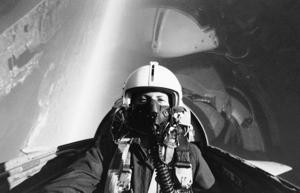
In this photo provided by NASA, Sharon Christa McAuliffe rides in a T-38 trainer jet over Galveston Bay during training for the launch of Space Shuttle Challenger mission 51-L. Part of Galveston Island and the Houston, Texas metropolitan area can be seen in background at top left, Jan. 16, 1986. McAuliffe, of Concord, N.H. will represent the Teacher in Space Project aboard the Challenger. (AP Photo/NASA) No Sales
“We are currently looking at all options but have not made a decision as to where the trainer will be built,” said Boeing spokeswoman Deborah VanNierop in an email. The trainer’s management team is in the St. Louis area, she added.
But an Air Force contract makes it likely that the main assembly will be in the U.S., and north St. Louis County is where Boeing makes its combat jets. Boeing assembled the Navy’s T-45 Goshawk trainer here in a program that ended in 2009 after 221 deliveries.
Boeing has a very good chance at landing the contract — if Congress provides the money, said Loren Thompson, a national security expert at the Lexington Institute in Alexandria, Va. But money is a big problem.
It’s unlikely that Congress will let the Pentagon loose from the “sequester,” Thompson said. Those are the automatic funding limits imposed after Democrats and Republicans failed to agree on spending in 2011.
The Air Force hasn’t yet put out specifications or asked for bids.
A new trainer is fairly low on the Air Force’s priority list, Thompson said. The generals are more interested in obtaining new F-35 joint strike fighters, new Boeing-built refueling tankers and a new long-range bomber.
Others aren’t so pessimistic about the new trainer.
A replacement for the T-38 “has to happen,” said Richard Aboulafia, vice president for analysis at the Teal Group, an aerospace consulting firm in Washington’s Virginia suburbs. “If you don’t start replacing them in the early 2020s, you have to spend an awful lot of money on structural work.”
And that means development on the new trainer must start fairly soon.
Thompson and Aboulafia disagree about Boeing’s chances of winning the contract if offered.
“Boeing probably has a wider range of experience than any of the other competitors,” said Thompson, who thinks Boeing has the lead. “It not only has a technological edge, but its the leader in the world in getting the costs down.”
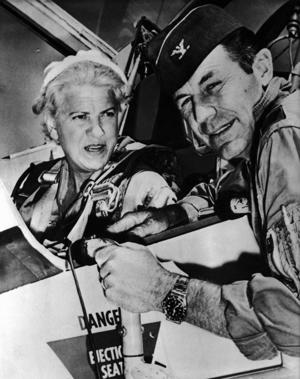
America's Veteran Woman Pilot Jacqueline Cochran sits in the cockpit of a T38 Jet Trainer with Colonel Chuck Yeager in the Edwards Air Force Base, California on Aug 25, 1961. The day before she made a record breaking flight at 842.6 miles an hour which is a new speed mark for women aviators. Colonel Chuck Yeager is the first man to fly faster than sound and who taught her to fly the T38. The present women's air speed record is 715.97 mph, held by Jacqueline Auriol of France, unseen. (AP Photo/Str/NAP)
Aboulafia finds Boeing more evenly matched. “I can’t give them more than a one in four chance,” he said.
The Air Force is looking for a trainer better adapted to preparing pilots for the F-22 and F-35, the newest attack fighters in America’s lineup. The requirements are likely to include high speed and the ability to sustain high g-forces.
The old T-38 is a supersonic aircraft capable of climbing to 30,000 feet in one minute.
“The challenge with T-X is, can we truly get a good trainer for a good price without doing development? That’s kind of our goal, not develop something new,” said William LaPlante, the Air Force’s undersecretary for acquisition in September, as quoted in the weekly military publication Air Force Times.
LaPlante said the requirements for the contract would be “reasonable enough that we can make sure there is a good, healthy competition for a non-development solution.”
The Air Force may also want a plane that can play the role of enemy aggressor in pilot training, Defense News reported last month, quoting budget documents.
The T-38 can’t imitate modern enemies well, and the Air Force may want an alternative cheaper than using F-35s in mock dogfights with student pilots. The winner of the trainer contract could produce a “red air” aggressor version.
According to Defense News, two top generals last month said there was no decision to design the T-X as an aggressor. Gen. Robin Rand, head of Air Education and Training Command, said he was intent on keeping the program on track just as a trainer.
The long-range bomber project provides a better bet for evmployment here, Thompson said. “The thing that’s going to stabilize employment in St. Louis the new bomber.”
Boeing, teamed with Lockheed Martin, is competing against Northrop Grumman for the bomber deal worth $55 billion over many years.
Winning that bomber contract is “a near certainty for Boeing,” said Thompson, although Aboulafia puts the likelihood at 50/50.
Last year, the state of California offered $420 million in tax breaks if Boeing builds the bomber in California, where the Air Force has its own secrecy-heavy plant. Boeing had requested the subsidy.
Such big projects are often shared around. St. Louis, as Boeing’s defense hub, could expect part of the work even if the North County plant didn’t land the major assembly job.