Показаны сообщения с ярлыком Virgin Atlantic. Показать все сообщения

суббота, 4 апреля 2015 г.

The big players in aviation are pinning their hopes on twin-engine jetliners like the Airbus A350 and Boeing 787 Dreamliner, which promise greater efficiency due to their groundbreaking composite designs. But with these planes set to take over more and more transoceanic routes, those two engines could be a problem. To follow the "great circle" routes that are the most direct routes between cities, which can save hours and lots of fuel on ultra long-distance flights, planes can fly far from land over remote stretches of ocean. With twin-engines planes, however, losing one engine could leave the jet searching for a place to make an emergency landing as quickly as possible.
And the closest airfield could be hundreds of miles away. Just this past weekend, a United Airlines flight from Honolulu to Guam diverted to the remote island of Midway, the site of an historic WWII battle, after the pilot reported smoke in the cockpit. This wasn't an engine failure; the cause was a malfunctioning equipment cooling fan, United said after it flew in a replacement plane to pick up the 348 passengers and crew. But this kind of problem isn't totally uncommon. Just two months earlier, a Delta 767 made an emergency landing on Wake Island, another WWII site with a rarely used runway left over from its days as a naval base. That time, the airborne emergency was caused by an engine problem, just the kind of scenario that's sparking worries about how far a twin-engine jet can stray from land.
Just six weeks ago, the two-engine 787 won FAA approval to fly as far as five and half hours from the nearest suitable landing strip, the same as the 777. That was a major coup for Boeing, especially after the jetliner's much-documented troubles with its lithium batteries. In fact, after the plane was grounded in 2013, the FAA hinted that it might not even grant the Dreamliner a more conservative 180-minute certification for extended twin-engine operations (ETOPS). That would have ruled out many routes over the Pacific, where distances are so vast that airlines also depend on a network of far flung diversion airports like Wake and Midway to comply with ETOPS requirements.
Years ago, airlines were permitted to fly twin-engine planes no more than sixty minutes from the nearest airfield. Once jets like the 767, 777 and A330 started replacing 747s and DC-10s on the North Atlantic, Boeing and others argued successfully that twin-engine jets were so reliable that it made little sense to restrict them. The costs saved by flying twin engines on long stretches are so compelling that many airlines made the switch on the longest routes.
Of course, any plane—even one with four engines—can have a in-flight emergency. A Qantas 747 reportedly once had to land on deserted Johnston Atoll in the southern Pacific, a chemical waste site that was decommissioned as a working airfield in 2007. Midway, about 1,300 northwest of Hawaii, is a protected sanctuary for the albatross, which apparently are such a danger to planes that landings can only be made safely at night for a good part of the year. Others include Shemya and Adak, two treeless and tundra-covered islands in the Aleutians chain off Alaska where winter temperatures can dip well below freezing. Flights taking polar routes can also avail themselves of some landing strips in Siberia in an emergency, where conditions are even harsher. Farther south in the Pacific and near the South Pole, there are even fewer alternatives, which is why Airbus was recently reported by the Wall Street Journal to be seeking an ETOPS of 420 minutes, or seven hours, to make possible non-stops on routes like Australia to Brazil or New Zealand to South Africa.
To fly the super long routes under ETOPS, the specific aircraft has to get a special certification that requires extra maintenance and rigorous checks as well as enhanced fire suppression and emergency systems onboard the plane. Among things, the jet has to demonstrate that it can safely fly on one engine for the maximum number of hours approved.
John Cox, a pilot and head of an aviation safety consultancy, says the ETOPS program actually has made long-distance flying safer overall. The twin jets that get this rating "are actually more robust than the earlier generation three- or four-engine airplanes," he says, and the latter can effectively operate without any restrictions on their distance from land. "We are now routinely flying over vast oceans with a better safety record."
But what if an engine does conk out? "Nobody likes losing an engine," Cox notes, no matter where they are, but this isn't the doomsday scenario most people assume. With the lower power generated by just one engine, the plane would go into what pilots call "driftdown", or flying at a lower altitude at slower speeds. As fuel burns off, the plane would be lighter and could ascend to higher altitudes. There are few routes in the world where the plane would be so far from an airport that it would need to take advantage of the maximum time allotted under the expanded ETOPS rules, he says.
Aircraft manufacturers, the FAA, and many safety experts say the record for ETOPS operations is excellent. But the public may take bit more convincing. After all, the industry's inside joke is that ETOPS stands for "Engines Turn or Passengers Swim."

суббота, 28 марта 2015 г.

Less Leasing Love From Lessors


6800196849_cfcc40776a_z
Image: Courtesy JDL Multimedia
New airplanes are good for everyone; that’s the story aircraft manufacturers are pushing and even some airlines are buying in to. With greater fuel efficiency, longer range, and higher capacity, the push is on to get new aircraft into every airline’s hangars.
United Airlines predicts that it will save approximately two million annually for each Boeing 757-200 it replaces with a new Boeing 737-900ER in its domestic fleet, for example, but this prediction is based when aviation fuel prices were much higher. Meanwhile, Allegiant has made a different business decision of flying old–but reliable–aircraft until they break; then, Allegiant will replace them with another inexpensive, older plane, but it would seem that Qatar Airways CEO Akbar Al Baker has a much different different approach as he recently suggested that the 787s his airline has recently acquired will be out of the fleet in less than a decade, making way for newer and larger aircraft.
Boeing expects to be producing 52 of its 737 aircraft each month by 2018 while Airbus is increasing its A320 family output to 46 per month by Q2 2016. Some widebody aircraft, such as the A330 or 747-8 families, are seeing reductions in production rates to partially offset the increase while others, including the 787 family, see increasing production rates to counter large backlogs.boeing-777-moving-line-starts2006_28409
And then there are those who worry about the ever increasing pace of aircraft delivery and its potential impact on the market overall. Many of them are in the aircraft leasing and financing business who are faced with a rapidly changing market structure and demand profile, one which the major manufacturers are upsetting with increased production rates.
CIT Aerospace, a lessor with roughly nine billion in aircraft under management, and plans to buy 15 A330neo aircraft, pressed for caution amongst the manufacturers in the near future. The statement was made at the International Society of Transport Aircraft Trading (ISTAT) conference recently amidst talk of an even greater push by Airbus and Boeing to capture market share.
Much of it comes down to residual value and amortization over time. The lessors historically have depended on a reasonably strong secondary market, often in secondary or tertiary countries, where used aircraft can operate reliably well after the initial service run at a major carrier. Today, however, more and more airlines are buying new from Airbus or Boeing rather than taking planes second-hand. More airlines are focusing on providing the comfortable passenger experience rather than simply transportation from A to B.
So airlines are owning new planes for shorter lifecycles and buying or leasing fewer used planes. This glut of inventory pushes down costs in the secondary market which is understandably bad for the lessors, but what does it mean to the broader industry as a whole? Passenger experiences are generally better on newer planes and the environmental impact is hard to argue, but for the airlines, is it better to run the newer aircraft with higher capital costs and lower operating costs or the older planes with that ratio reversed? Especially if the secondary market continues to see declining prices. This will impact the first owners of new planes down the line as they look to unload and cash out on the airframe.
Ultimately, this could portend an inversion in the market where the traditional legacy carriers start operating more and more second-hand planes to better control total costs while the upstarts, flush with investor cash or loan guarantees, happily take the new planes off assembly lines around the world. And, in the middle, the private-sector financing groups will struggle to make a profit from the industry where public financing seems spectacularly easy to secure.

четверг, 26 марта 2015 г.

U.S. Air Force overstepped bounds in SpaceX certification: report

The unmanned Falcon 9 rocket, launched by SpaceX and carrying NOAA's Deep Space Climate Observatory Satellite, lifts off from launch pad 40 the Cape Canaveral Air Force Station in Cape Canaveral, Florida February 11, 2015. REUTERS/Scott Audette

The unmanned Falcon 9 rocket, launched by SpaceX and carrying NOAA's Deep Space Climate Observatory Satellite, lifts off from launch pad 40 the Cape Canaveral Air Force Station in Cape Canaveral, Florida February 11, 2015.
CREDIT: REUTERS/SCOTT AUDETTE


(FlightClub) - The U.S. Air Force overstepped its bounds as it worked to certify privately held SpaceX to launch military satellites, undermining the benefit of working with a commercial provider, an independent review showed on Thursday.
The report cited a "stark disconnect" between the Air Force and SpaceX, or Space Exploration Technologies, about the purpose of the certification process and recommended changes.
Air Force Secretary Deborah James ordered the review after the service missed a December deadline for certifying SpaceX to compete for some launches now carried out solely by United Launch Alliance, a joint venture of Lockheed Martin Corp and Boeing Co.
The Pentagon is eager to certify SpaceX as a second launch provider, given mounting concerns in Congress about ULA's use of a Russian-built engine to power its Atlas 5 rocket.
The Air Force said on Monday it was revamping the certification process, but did not release the report on the review until Thursday and hoped to complete the work by June.
The report, prepared by former Air Force Chief of Staff General Larry Welch, said the Air Force treated the process like a detailed design review, dictating changes in SpaceX's Falcon 9 rocket and even the company's organizational structure.
That approach resulted in over 400 issues that needed to be resolved, which was "counterproductive" to a national policy aimed at encouraging competition in the sector.
In fact, the process was intended to show that SpaceX met overall requirements to launch military satellites, not carry out the more detailed review required for each launch on a case-by-case basis, he said.
Welch faulted SpaceX for assuming its experience launching other Falcon 9 rockets would suffice to be certified, and not expecting to have to resolve any issues at all.
"The result to date has been ... the worst of all worlds, pressing the Falcon 9 commercially oriented approach into a comfortable government mold that eliminates or significantly reduces the expected benefits to the government of the commercial approach. Both teams need to adjust," he said.
He urged the Air Force's Space and Missiles Systems Center to "embrace SpaceX innovation and practices," while SpaceX needed to understand the Air Force's need to mitigate risks, and be more open to benefiting from the government's experience.

Here's Why Airliners Still Don't Have Real-Time Tracking Tech

It's been one year since Malaysia Airlines Flight 370 vanished into thin air. So why aren't we doing a better job of tracking planes yet?

From the moment MH370 disappeared more than one year ago, the world has been asking how a jumbo jet carrying 239 people could vanish. Now, the aviation industry is grappling with another question: Where are the promised flight tracking systems that would prevent this from ever happening again?
The technology would transmit in real time a multidimensional picture of an aircraft's position, measured by longitude, latitude, altitude, and the local time as provided by satellites. This is the same data that is captured by the flight data recorders (the black boxes), which, in the case of MH370, are presumed to be somewhere in the depths of the Indian Ocean. However, the International Air Transport Association (IATA) said it might not be possible to meet its goal of making all aircraft traceable within a year—something that had seemed a reasonable deadline in the aftermath of MH370.
Tony Tyler, the former Cathay Pacific executive who heads the 250-member airline trade group, said that while the group is taking the issue "seriously," it's not clear whether all carriers are on board with the timetable.
"There is no silver bullet solution on tracking," he said at a briefing in Geneva. "The industry is working to improve, but some issues…. will take time to address and implement," he added, noting that the sealing of cockpit doors after the Sept. 11 attacks took several years to complete.
So what's the problem? The IATA just released a study from its Aircraft Tracking Task Force, which, after the disappearance of MH370, was charged with developing tracking options for planes. The study's main focus is how to track planes in areas that have no radar coverage, such as remote areas over water. Thanks to the modernization of air traffic control systems, that tracking is already improving, but that alone won't be enough to track all planes if airlines don't make their own upgrades.
The IATA report is supposed to contain information about how many airlines are already equipped for real-time tracking, but the details have not yet been made public. We do know the authors conclude that some may not be able to meet the new standards by target date of the end of 2015.
Plus, there's the question of authority: The IATA can't make the airlines fall in line and add new tracking tech. Any governmental action to require such tracking must come via the U.N.'s International Civil Aviation Organization, which could put pressure on individual countries to act if it sees fit. The issue next goes before them at a summit in February.
The study also raised the prospect of requiring carriers to acquire tamper-proof transponders within three years. A criminal investigation under way in Malaysia is examining the possibility that someone on the plane intentionally disabled the transponder of the 777, which effectively made it untraceable and allowed it to fly undetected for hours. But IATA stopped short of saying that the new transponders should be mandated.
There's also disagreement on how much it will cost. The upgrades could cost tens of thousands of dollars per aircraft, and many airlines have expressed concern about the high cost given how rare it is for an aircraft to disappear.
Of course, those same arguments were made after Air France 447 crashed into the South Atlantic in 2009, when the industry had an opportunity to make the changes that might have prevented MH370's disappearance.

“Living in the Age of Airplanes” Is a Visually-Stunning Aviation Film for All Ages


I recently had the opportunity to attend a pre-release screening of National Geographic’s new IMAX film, “Living in the Age of Airplanes.” I first saw the trailer last fall and was immediately excited to see it. Being the aviation geek that I am, I held high expectations, and I’m happy to be able to say they were met.
The project was produced and directed by Brian J. Terwilliger, who is also known for the aviation film “One Six Right.” The runtime of the show was 47 minutes, and the producers maximized every minute with absolutely stunning cinematography, paired with majestic music tracks by Oscar-winning composer James Horner and narration by Harrison Ford. The show opened in the famous “Airplane Graveyard” in Mojave, California, with sad, parted-out 747s as Ford spoke about how air travel is now taken for granted.
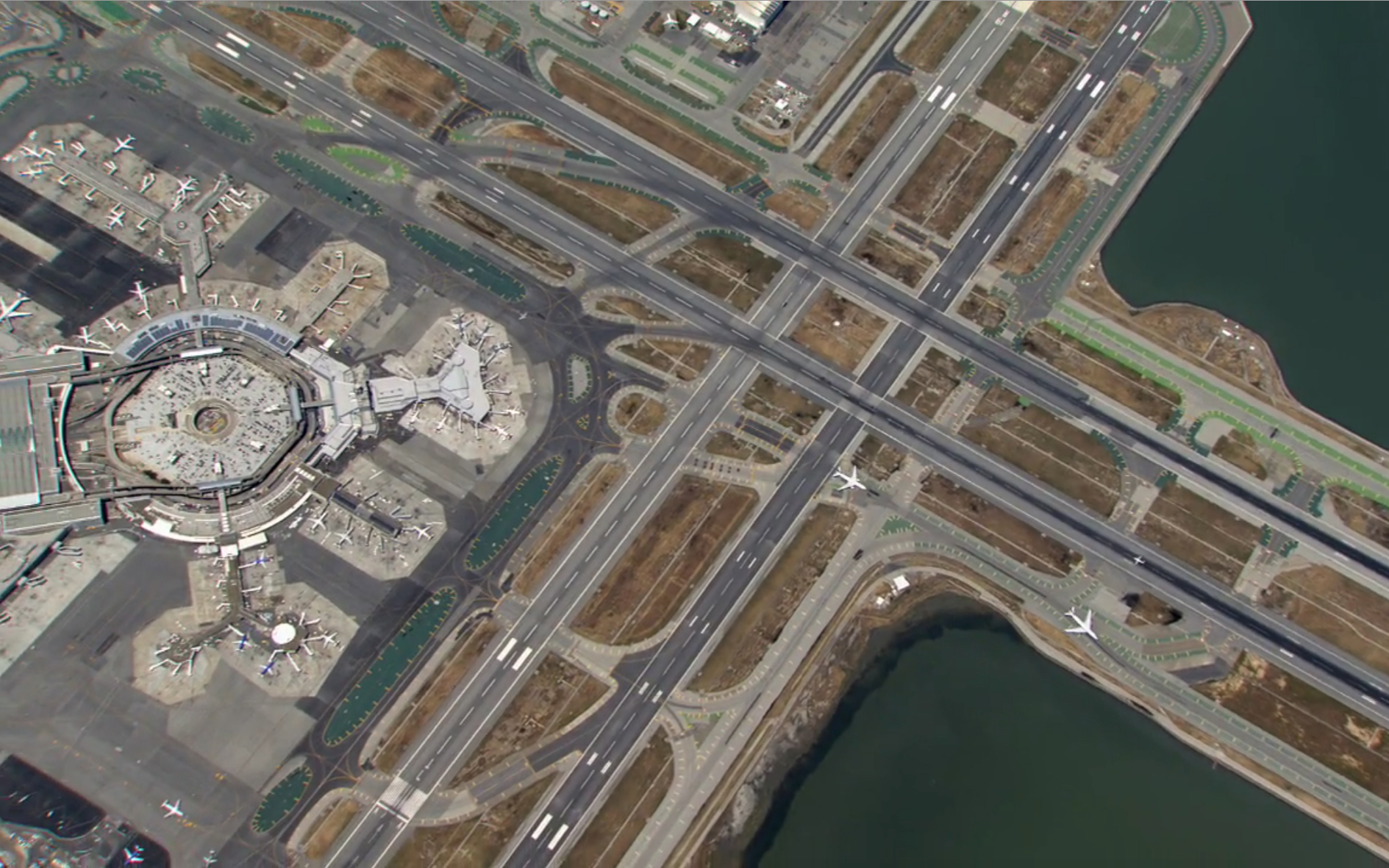
Movie - SFO Overhead
Next, we are taken down a timeline of human transportation. Beginning 200,000 years ago, humans had only one mode of transportation – our own two feet. Then roughly 5,000 years ago, the wheel was invented, and we began having animals pull us along. Fast-forward to the 1600s, when sailing ships took us across the seas and expanded our globe. In the 1800s, steam trains, and later, steam ships, propeller planes, and finally, the Jet Age.

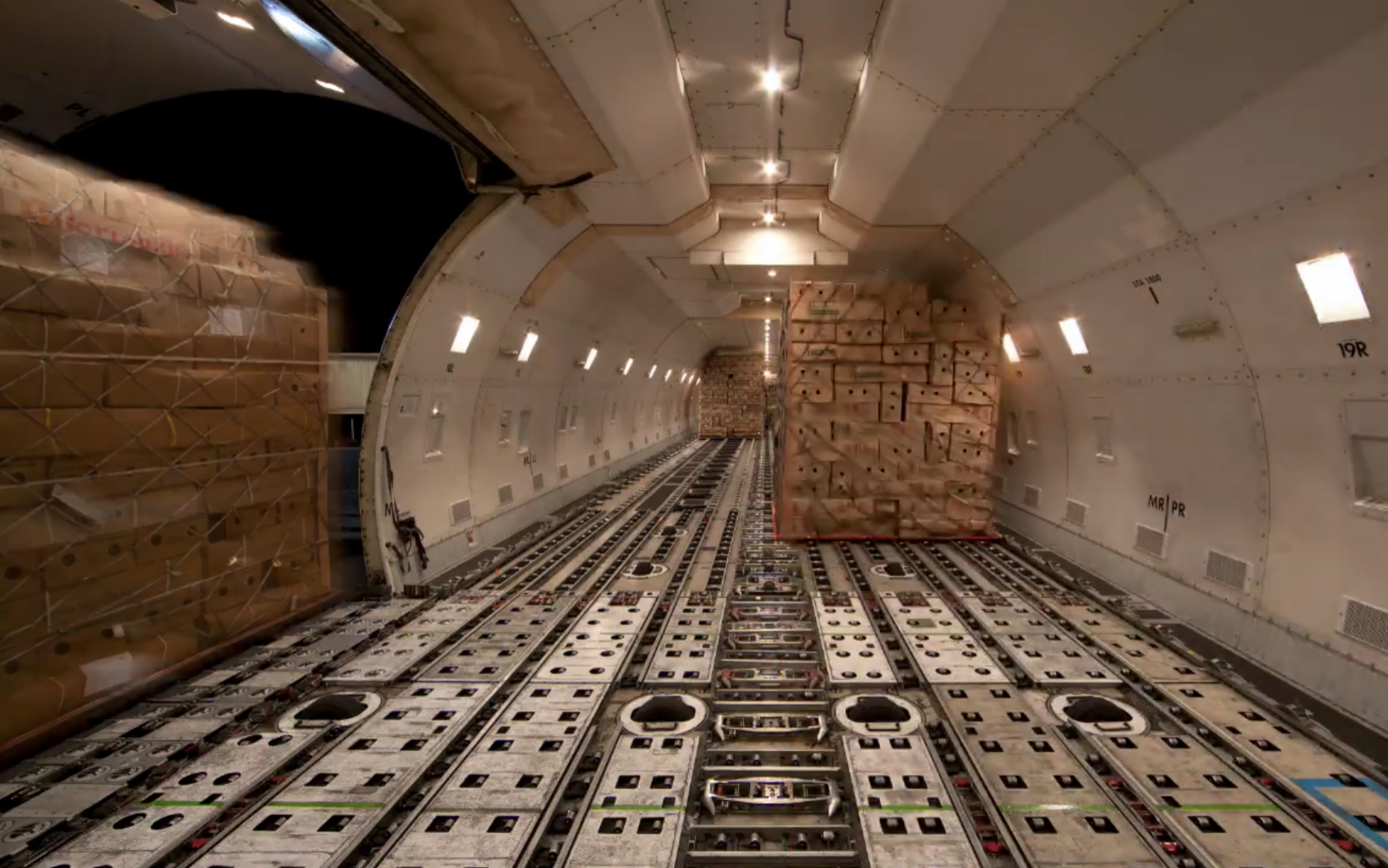
Movie - Cargo Plane Interior
Another focus of the film is the importance of the global air cargo network. To demonstrate this, we see a bouquet of long-stemmed roses make its way from the grower in Kenya, to the wholesale market in Amsterdam, to a vase in Alaska in just over seventeen hours. We also see how our homes are a melting pot for produce, garments, and housewares from all over the globe.
In the final scene, we’re given a look at our own perspective as travelers. When we fly, we often sit there without realizing we’re going anywhere, Ford says. But taking a look out the window, from 35,000 feet; we see more of our Earth in one glance than most of our ancestors saw in their whole life. This window seat perspective is what I love most about aviation.
Movie - Float Plane
The cinematography alone makes this film worth seeing. A few scenes that come to mind: a United Boeing 777 traversing the taxiways at SFO as the camera ascents straight up to give a view of the whole Bay Area. A montage of Airbus A380s on takeoff. Seaplanes landing on azure waters in the Maldives.
If I could improve anything about the film, it would be two things. First, I wish it were longer. Those 47 minutes really flew by, no pun intended. However, the movie’s reps on Twitter said the run time is right in the “sweet spot” for IMAX films. I would also have liked to see some content on the manufacturing process. So many advances have been made in the past couple of decades, including composite fuselages, glass cockpits, and eco-friendly fuels.
Perhaps a follow-up film will cover how planes are built and tested. I’ve been fortunate to tour the assembly lines where some commercial aircraft are built, and it never ceases to amaze me the amount of knowledge and effort that goes into building planes.
Everyone should see this film. It is appropriate for all audiences, from interested kids to the jaded million-mile flyers. It is my love and fascination of planes, put into images – and it’s incredible.
All photos are screenshots taken from the video, cited to National Geographic. 

Авиакомпания "Wizz Air Украина" прекращает свою деятельность

Wizz Air Holdings Plc (вместе с дочерними компаниями, Wizz Air или "Группа") сообщает о том, что будет продолжать реструктуризацию деятельности в Украине
С 20 апреля 2015 года Wizz Air Hungary будет выполнять 8 рейсов в Украину и из Украины. 4 июня 2015 года состоится открытие базы в Киеве, на которой будет базироваться один самолет Airbus A320. Также 20 апреля авиакомпания "Визз Эйр Украина", которая в настоящее время выполняет 16 рейсов на двух самолетах, прекратит свою деятельность. Об этом сообщает пресс-служба компании.
"Второй самолет Airbus A320, который сейчас базируется в Киеве, будет перемещен на новую базу Wizz Air в Кошице, Словакия, и будет выполнять рейсы из Кошице в Милан Бергамо и Шеффилд-Донкастер с начала июня 2015 года.
В продолжение сокращения авиапарка "Визз Эйр Украина" в прошлом году потребовалась дальнейшая оптимизация и реструктуризация активностей Wizz Air в Украине. Это связано с продолжающейся нестабильностью в Восточной Украине, девальвацией и нестабильностью местной валюты и влиянием контроля обмена валюты. Wizz Air Hungary постарается уменьшить влияние данных факторов и позволит Wizz Air остаться одной из ключевых авиакомпаний на украинском рынке. Авиакомпания будет готова к расширению активностей в Украине, когда ситуация на рынке улучшится", - говорится в сообщении компании.

понедельник, 23 марта 2015 г.

France, Germany Protest Gulf Carrier Encroachment

As U.S. airlines and labor unions launch their campaign against alleged subsidies for the “Big Three” Gulf carriers, the debate is already well underway in Europe. Key players in transport policy seek a new agreement with Gulf states to regulate subsidies, but Gulf countries and carriers are strongly resisting the effort.
While the white paper issued on behalf of U.S. majors has made many headlines, European airlines have been lobbying against Emirates, Qatar Airways and Etihad Airways for years. A larger part of their networks is affected by the new competitors, and as the investments by Etihad into the subsumed Alitalia (Etihad now owns a 49% share of the Italian flag carrier)show, they not only face them on long-haul services, but also within Europe.
Thus the Gulf carriers are facing a new level of scrutiny and pressure. The European Commission appears to be seeking a mandate from its member states to negotiate with the Gulf states following the disappointing first round of talks, according to Transport Commissioner Violeta Bulc.

The process was initiated by a joint letter from Air France-KLM and the Lufthansa Group to the EC last December in which the two airline groups and several of their subsidiaries stressed that competition with Gulf carriers should be more equitable. They did not say precisely what action they would like the EC and governments to take, but French and German transport ministers Alain Vidalies and Alexander Dobrindt, respectively, jointly proposed that Gulf carriers should not be granted additional traffic rights into the European Union until fair competition is ensured.
The German and French ministers write that they welcome “the clear message of the [EC] to the Gulf Cooperation Council (GCC) as to the legitimacy of the member states to refer to the lack of progress in the dialog to delay negotiations with the Gulf countries or to refuse to grant new traffic rights.” 
The transport ministers further state:  “Despite major adaptation, . . . European airlines have kept on losing market share to their competitors in the Gulf countries on many destinations such as the Indian subcontinent, Asia, especially Southeast Asia, Oceania and Eastern Africa.” The letter, which has not been publicly released, was obtained by Aviation Week. 
Noting an urgent need to act, the two ministers say the situation “severely harms European carriers, reduces the attractiveness of European hubs and severely threatens the connectivity of the European Union with the rest of the world.” They suggest that a response could “take the shape of a comprehensive air transport agreement with the Gulf countries [if] certain conditions are met.”

These conditions include a guarantee of fair competition, financial transparency, detailed provisions on subsidies, unfair practices and competition, as well as giving the EC and member states “efficient means of action, going beyond the usual dispute-settlement mechanism in case of non-compliance with these provisions.”
The opening of European markets, they say, should be gradual and limited. Only third- and fourth-freedom rights should be covered in a comprehensive air service agreement, and further traffic rights to Gulf airlines would be linked to “a positive evolution of the competitive environment,” the ministers say.
The third and fourth “freedom of the air” dicta cover the rights to carry traffic to and from an airline’s home country. But the Gulf carriers’ business model is built to a large degree on connecting traffic and beyond (sixth freedom), thus the condition has to be unacceptable to the GCC and its airlines.
A similar proposal has now been put forward by Delta Air Lines CEO Richard Anderson, who says new U.S. agreements with Gulf states should preclude Emirates, Etihad and Qatar from offering trips that don’t end in their home markets (or the U.S.). This proposal would be equivalent to a ban on connections, the very model under which Delta and many other carriers in the U.S. and Europe are operating.
Noticeably absent from the protest is the U.K., the only one of the three countries that has an open skies agreement in place with the United Arab Emirates (UAE). Unlike other bilaterals, it includes a clause on fair competition. The U.K. has traditionally favored open competition and is against interfering in issues such as regulating how airlines are financed by governments. That position is supported by International Airlines Group, which is now partly owned by Qatar Airways.
Exactly what Transport Commissioner Bulc is seeking remains to be clarified. A spokesman says the EC is “considering to propose a number of EU-level air transport agreements with certain important third countries.”
Such a potential agreement between the EU and GCC would supersede the bilaterals now in place between individual countries. The EC would insist on including a fair-competition clause, an issue it has been discussing with the Gulf states for some time now. Along the lines of the German and French position, it is understood to have asked members to refrain from new bilateral agreements with Gulf countries unless fair-competition clauses are included, a move that has been criticized by the Arab side.
The process is unlikely to lead to a satisfactory result from a European point of view. Most current bilaterals do not include clauses that define “fair competition”; any change would be subject to approval by the Gulf states themselves, and they have no interest in signing up for a common deal that is more restrictive than the one in effect.
Meanwhile, in Washington, Emirates Airline President Tim Clark and Etihad CEO James Hogan vigorously defended their positions in a recent series of meetings, which came on the heels of a push by Delta, American AirlinesUnited Airlines and several of their unions to limit the Gulf carriers’ access to the U.S.  
Claiming these airlines received almost $40 billion in subsidies, the three U.S. carriers are calling for the U.S. government to begin consultations with the governments of Qatar and the UAE. Until there is a resolution, the U.S. carriers contend, no new Gulf carrier capacity to the U.S. should be allowed. But critics point out that this condition would abrogate the open-skies treaty.
Clark expressed hope that the U.S. policy of open skies will remain unfettered nonetheless. “Open skies is probably the most powerful global ‘aeropolitical’ tool,” he said, praising the U.S. government for negotiating liberalized treaties with more than 100 countries. Emirates is not in violation of the treaty, he said in Washington on March 17.
Clark said that, other than seed money from Dubai when Emirates was launched 30 years ago, the airline has received no government subsidies. “Make your own way in as stylish a manner as you think you can,” Clark said was the mandate from the state. In response to assertions that Dubai absorbed more than $4 billion in fuel hedges for Emirates, Clark simply said, “tosh.”
The U.S. carriers’ claims are detailed in a report they released earlier this month that had previously been circulated among lawmakers and officials from the State, Transportation and Commerce departments. Clark said Emirates is evaluating the report: “We have to check all of this to make absolutely sure that what has been said . . . has not been taken out of context or in a manner . . . that will help the people that produced the report.”
The Gulf carriers, including Emirates, are adding capacity to the U.S. that far outstrips demand, given that there is very little origin and destination traffic between the U.S. and Qatar and the UAE, an industry insider familiar with the U.S. airlines’ position tells Aviation Week. This means Gulf carriers are siphoning traffic to Asia and beyond from U.S. carriers and their partners at a scale with which the U.S. carriers cannot compete, thanks to what they say are unfair subsidies from the Gulf governments. 
“We cannot compete with airlines that benefit from government subsidies,” the source says. “If [the Gulf carriers] are not going to operate as commercial airlines, then our doors shouldn’t be as open as they are today.”
Clark rebutted this claim in his remarks, saying: “It’s a little bit of the pot calling the kettle black.” He points out that most large international airlines in Europe and Asia earn money through connecting traffic. Lufthansa, Air France, KLM and Singapore Airlinesmake significant amounts of money through connecting traffic.  
The mission now, Clark says, is to prove to the U.S. government that Emirates is not subsidized. If questions remain after he has done so, he said, he would then argue that U.S. carriers’ access to protection under Chapter 11 of the U.S. bankruptcy code, as well as support airlines received post-9/11, give them an unfair edge.
Etihad’s CEO, too, rejected the U.S. claims. According to Hogan, the carrier has always made clear it has received equity investment and shareholder loans. Those have been “supplemented” by $10.5 billion in loans from international institutions, he says.
“It is surprisingly hard to find financial information about the first one or two decades of national airlines around the world,” Hogan says. “We get criticized regularly for our so-called lack of transparency, but we see few national airlines that were as open in their first stages of development as we are being in ours.” Also, Hogan argues that Etihad has had “a greater focus on reaching and delivering sustainable profitability—we believe—than any other airline in history.” He underscores that his airline beat its target to post a profit within 10 years of its launch.
Hogan dismisses claims that governments should stay out of air transport. “Why can’t a state invest in building an airline?” he asks. While European airlines were often privatized for €1 ($1.09) or 1£ ($1.51), he argues, Etihad had to build an airline from scratch. Therefore he says, “I don’t apologize for anything.” 
Referring to the government of Abu Dhabi, Hogan says: “Our shareholder believes in our business plan. They have increased their commitment as we have developed—they have invested in our success.” As any rational shareholder in the world would, the government “expects a return,” he says. “The key word is ‘return.’”
Hogan says passengers opt to fly Etihad instead of many other competitors. “But quite honestly, it is very rare that U.S. carriers offer those alternatives,” he says. “No U.S. carrier flies into Abu Dhabi. There are very few U.S. carriers operating to where we do in the Indian subcontinent, in Southeast Asia or in the wide Middle East.”

суббота, 21 марта 2015 г.

Google Can Tell You Whether Your Flight Will Have Wi-Fi

It knows how much legroom and how many power outlets you'll be getting, too


Google's flights search engine now reveals details about the aircraft that will take you to your destination, including whether WiFi services are available.
The web giant has entered a deal with Routehappy to include details about internet, seat type, legroom, power sockets and more in its listings.
"We know people are looking for more information about the flights they're taking before they buy, so integrating Routehappy Happiness Factors is a great addition to Google Flights," said Google's Gianni Marostica.
"Now even more people have access to comprehensive flight amenity data and useful flight search information."
Google's flight searches now include small icons to denote the inclusion of WiFi, power sockets and other services beside the user's results.
Last year, Virgin Atlantic began trailing the use of Google Glass to speed up passenger check-ins and enhance customer service

From: Digital Spy